The Complete View Of World Beautiful Attractions, Destinations, World Wonders, Best Tour Guide, Natures, hill stations, Sea Sore Attractions, World Famous Heritage Towns, Temples and More..........
Showing posts with label spain tourism. Show all posts
Monday, January 30, 2017
Ciudad de las Artes y las Ciencias, Valencia
When Valencia diverted the course of the river that had repeatedly flooded the city, it was left with a broad, flat riverbed spanned by bridges. It was upon this clean palette that the brilliant Spanish architect Santiago Calatrava created a breathtaking ensemble of structures that have become a magnet for aficionados of contemporary architecture. Not only the buildings, but the museums, arts venues, and aquarium (by Félix Candela and the only building not designed by Calatrava) form a series of tourist attractions that rank among Spain's most popular. Europe's largest oceanographic aquarium, L'Oceanogràfic, was built in the shape of a water lily with buildings dedicated to different aquatic environments from the tropics to the poles.
Plaza Mayor, Madrid
The throbbing heartbeat of Spain's vibrant capital city, Plaza Mayor has played an important part in Madrid life since the 16th century, when Philip II entrusted the task of designing it to his favorite architect Juan de Herrera, builder of the Escorial. It has served as the stage for ceremonial events - the proclamation of a new king, the canonization of saints, the burning of heretics - and public entertainment such as chivalric tournaments and bullfights. The cafes reaching out onto its pedestrian-only stone pavement, and the restaurants shaded under its arcades are Madrid's living room, popular meeting places for Madrileños and tourists alike.
Santiago de Compostela Cathedral
The magnificent cathedral of Santiago (St. James) was built to house and honor the relics of the saint, and it has been the goal of pilgrims since the Middle Ages, the culmination of their completing the famed Camino de Santiago. One of the outstanding monuments of Early Romanesque architecture, the cathedral was built between 1060 and 1211, and despite the Baroque transformation of the exterior in the 16th to 18th centuries, the interior is still in the purest Early Romanesque style. You'll see both of these periods at play as you enter the west front, through one of Spain's most impressive church facades. Step inside to face the Pórtico de la Gloria, part of the old west front now concealed by the 18th-century facade. This triple doorway is one of the largest and most magnificent collections of Romanesque sculpture in the world.
The focal point of the interior is the elaborately decorated Capilla Mayor, built over the Apostle's tomb. In the center of the high altar of jasper, alabaster, and silver is a 13th-century wooden figure of the Apostle, richly adorned in precious metals and gems. On either side, narrow staircases lead up behind the figure so that pilgrims can kiss the Apostle's cloak - culminating their pilgrimage. In a crypt under the altar, the Apostle's remains are in a silver casket.
Seville Cathedral and Alcazar
La Giralda tower, Seville Cathedral, and the Alcazar combine to form a UNESCO World Heritage Site. The tower is a minaret, a "masterpiece of Almohad architecture," according to UNESCO. The cathedral has more interior space than St. Peter's in Rome and a 37-meter main altar of carved statues completely covered in gold. The monumental tomb of Christopher Columbus is held aloft by a quartet of larger-than-life figures. La Giralda, the emblem of Seville, began life as a minaret and is all that's left of the city's Great Mosque, destroyed to build the cathedral.
The Alcazar opposite was begun by the Moors in 712 and continued after the Christian re-conquest by King Pedro in the 1300s in the ornate neo-Moorish style called Mudejar. The rooms and salons are breathtaking, and the gardens a joy to stroll in, shaded by fragrant orange and lemon trees. Adjoining on the east is Santa Cruz, the former Judaria (Jewish Quarter), a neighborhood of whitewashed homes, iron balconies, and flower-filled courtyards.
Guggenheim Museum, Bilbao
You really have to see this building to believe it - no photograph has ever done justice to this symphony of shapes, so alive that they seem ready to take wing. American architect Frank Gehry used blocks of limestone and undulating sheets of titanium to turn the notion of modern architecture on its ear. So thoroughly did he succeed that two new terms were born from it: "The Bilbao Effect" - the ability of a city to turn its fortunes around by constructing a single world-class building - and "architourism", a whole segment of the travel industry revolving around landmarks of contemporary architecture. Inside the museum are traveling exhibitions and rotating displays of its own collections of modern art.
San Lorenzo de El Escorial
San Lorenzo de El Escorial, about 45 kilometers northwest of Madrid, was the summer home of Spain's kings, and in 1563, work was begun there on a huge complex, which would include a monastery, church, royal palace, mausoleum, library, and museum, all conceived as a monument to Philip II and his reign. The result is a staggering collection of attractions, built around 16 courtyards, its rooms and structures connected by 16 kilometers of corridors. At its core is the church, the highlight of which is Herrera's 30 meter-high retablo, made of jasper and red marble and approached by a flight of 17 steps.
Along with the vaulted and frescoed ceilings by Tibaldi in the rooms off the lower cloister, highlights of the monastery are the Panteón de los Reyes (the Baroque burial vault of the Spanish kings) and the library, a grand room also decorated by Tibaldi frescoes. In the palace, be sure to see the Bourbon Suite, where the state apartments of Charles IV are decorated with rare furnishings and 338 tapestries. Beyond are the art-filled private apartments of Philip II. The Picture Gallery below has a large collection of fine paintings, including works by Hieronymus Bosch, Albrecht Dürer, Titian, Tintoretto, Veronese, Velázquez, and El Greco.
The Prado and Paseo del Artes, Madrid
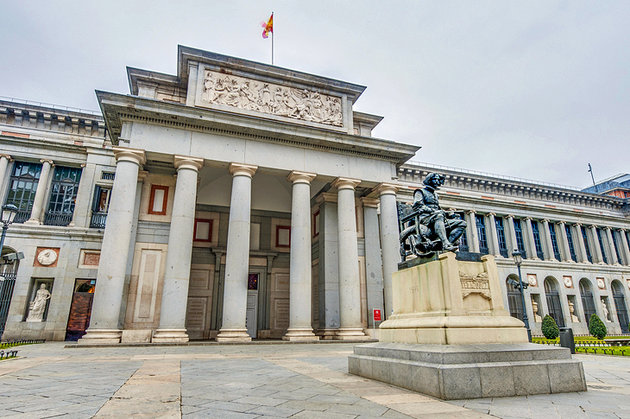
The Prado alone ranks with the world's top art museums for the riches of its collections. But add the Reina Sofia National Art Museum, the Thyssen-Bornemisza Museum, and the CaixaForum, all along Madrid's mile-long, tree-shaded boulevard, and you have what may be the world's highest concentration of priceless art treasures. It's no wonder this is known as El Paseo del Arte - Boulevard of the Arts.
After a 2007 expansion that doubled its exhibition space, the Prado added another 12 galleries in 2009 to house a collection of works by Goya and other late 19th-century artists. The Prado has the world's largest collection of Spanish art, an impressive continuum from 12th-century medieval works through the avante-garde movement of the early 20th century, and is especially noted for its works from Spain's golden age by El Greco, Velazquez, and Goya. But its riches are not all Spanish; other highlights are the medieval murals and retablos, paintings by Flemish and Dutch artists (be sure to see the fantasy world of Hieronymous Bosch and works by Rubens and Brueghel), and Italian art (Botticelli, Raphael, Correggio, Titian, and Tintoretto). Highlights of the Reina Sofia's impressive 20,000 works are Picasso's Guernica and works by Miró, Dalí, Dubuffet, Braque, Serra, Calder, and Magritte.
Barcelona's Sagrada Familia and Gaudi Sites
Antoni Gaudi took the architectural style known as Art Nouveau a step farther, even, some have argued, into absurdity. The fanciful and outrageous buildings he created in Barcelona have become landmarks, the signature attractions of this Catalan city. Foremost is The Sagrada Família church, officially the Temple Expiatori de la Sagrada Família or the Holy Family Church of the Atonement. One of Europe's most unconventional churches, it is also unfinished, so as you look down from its tower you can see the work in progress below.
You may search in vain for absolute straight lines in Gaudi's Casa Milà, his last and most famous secular work; it resembles a piece of sculpture more than a functional building. Be sure to ascend to its roof - the chimneys are said to have inspired the image of Darth Vader from Star Wars. Parc Güell overlooks the city from a hillside, the views and gardens framed by fantastical creatures - salamanders, fish, an octopus - and designs in bright ceramic-chard mosaics. A fanciful towered house near the entrance is largely covered in colored ceramics. Unlike most buildings, Gaudi's appeal even to children and to adults who don't care a thing about architecture, for one simple reason - they are just plain fun to look at.
Subscribe to:
Posts (Atom)


